
TCS Nashik Case Aftermath: Your Guide to the New PoSH Compliance Checklist (May 2026)

The corporate landscape in Maharashtra has shifted significantly following the National Commission for Women (NCW) report on the Tata Consultancy Services (TCS) Nashik case. This investigation uncovered a "toxic workplace environment" that has served as a critical catalyst for a new regulatory regime. In response to the systemic failures exposed, the Government of Maharashtra notified a comprehensive inspection checklist on May 15, 2026, which every workplace must now implement to ensure the safety and dignity of women.
The NCW took suo moto cognisance of complaints at TCS Nashik, establishing a Fact-Finding Committee that visited the site on April 18 and 19, 2026. Their findings, submitted to the Chief Minister of Maharashtra on May 8, 2026, were harrowing:
Severe Exploitation: Complainants faced sexual harassment and attempts at molestation by individuals who had assumed "effective control" of the office and targeted vulnerable employees.
Coercive Environment: The accused bullied female employees by insulting Hindu traditions, beliefs, and practices, creating a hostile atmosphere by attempting to impress upon them that another faith was superior.
Leadership Failure & Retaliation: A complete breakdown of local leadership meant victims were afraid to speak out due to fear of professional repercussions, including transfers or terminations. The investigation found that certain leaders, through silence and insensitivity, effectively endorsed these acts.
Security Lapses: Critical safety failures were evident, including non-functional CCTV systems that failed to provide basic workplace monitoring.
"Zero Compliance" of the PoSH Act: There were no informational placards or awareness programs, and the Internal Committee (IC) was a common committee shared between Pune and Nashik—a direct contravention of the Act.
This "governance deficit" and the complete failure to provide a dedicated safety mechanism at the local unit level served as the primary driver for the state's intervention. To translate the NCW's recommendations into enforceable law, the Government of Maharashtra's new inspection framework specifically targets these organisational loopholes.
By shifting from a centralised approach to one of strict, localised accountability, these new guidelines ensure that PoSH compliance is no longer a "paper-only" exercise. Here is a breakdown of the critical shifts your organisation must implement immediately to survive a government audit.
Extending PoSH Policy to Remote, Virtual, and Hybrid (WFH) Environments
The investigation into the TCS Nashik unit revealed a "toxic workplace environment" where a lack of monitoring—specifically non-functional CCTV systems—contributed to a climate of fear. In a remote or hybrid setting, this "monitoring" translates to digital oversight and cyber-safety.
The new regulatory framework acknowledges that harassment does not stop at the office door. Under Part A of the government checklist, inspectors will now specifically verify: "Does the policy include remote/virtual (Work from Home) work environments?".
This shift is critical because Digital safety is now a statutory requirement as per the Section 19(a) of the Act which requires employer to provide a safe working environment, which now encompasses safety from persons coming into contact with employees through digital interfaces.
Therefore, to comply with the new government standards and survive an audit, HR and business leaders must ensure the PoSH policy must explicitly state that it covers virtual meetings, official messaging apps, and any digital interaction that occurs in the course of employment.
Establishing Dedicated Internal Committees (IC) for Every Branch (The 10+ Employee Rule)
The NCW investigation into the TCS Nashik unit identified a major "governance deficit": the company was using a common Internal Committee for both its Pune and Nashik offices.
This meant that not a single IC member had ever visited or inspected the Nashik unit, leading to a complete absence of a trustworthy environment where victims felt safe to speak up.
To eliminate such organisational loopholes, under Part A of the government checklist, inspectors will now verify: "Has an Internal Committee (IC) been established in every office/unit?".
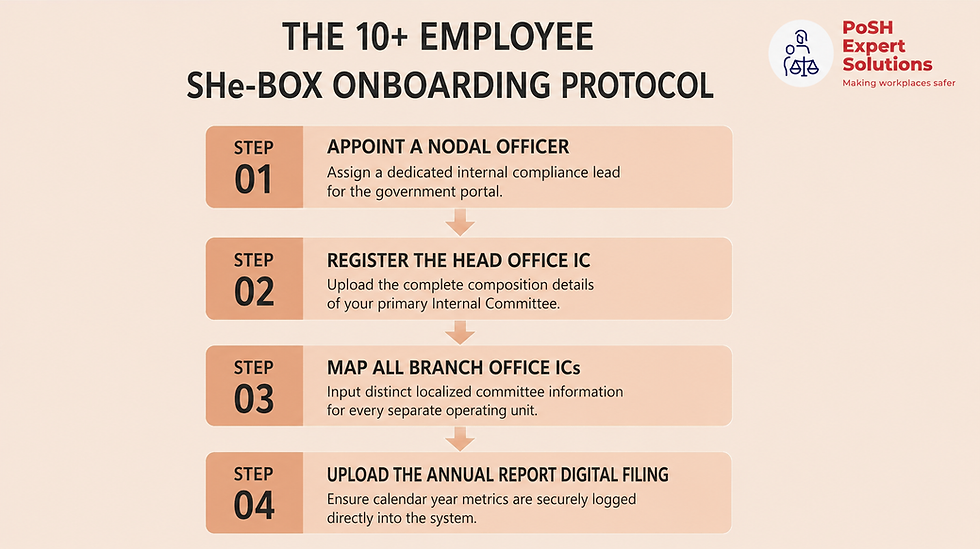
This shift is critical because the state has now introduced a strict digital threshold for reporting where organisations are specifically required to appoint a Nodal Officer and update their details on the SHe-Box portal for every single office that employs 10 or more people.
Therefore, to comply with the new government standards and insulate your business from liability, business leaders must move beyond "paper-only" compliance. You must ensure that every operational unit has its own valid IC—consisting of at least 4 members and 50% women—and that these details are digitally logged for every location crossing the 10-employee mark
Mandatory Digital Visibility: SHe-Box Portal Onboarding and Public Website Disclosure
The investigation into the Nashik unit revealed a state of "Zero Compliances" regarding awareness: there were no informational placards, no boards displaying IC member contact details, and "no iota of any material" to inform employees about the consequences of harassment. In modern corporate environments, physical posters are no longer sufficient; safety information must be impossible to ignore.
The new regulatory framework shifts PoSH compliance from "hidden" internal documents to public digital accountability. The government now mandates:
Organisations must ensure that their PoSH Policy and a direct link to the SHe-Box portal are available on their official website and official social media channels.
For every office or unit employing 10 or more people, the organization must appoint a Nodal Officer and update their details on the SHe-Box portal.
It is no longer enough to list only the Head Office IC. Organizations are now strictly audited on whether they have uploaded the IC details for every branch office to the SHe-Box portal.
To ensure active monitoring, the Annual PoSH Compliance Report must now be uploaded directly to the SHe-Box portal, making it instantly accessible for government inspection.
By implementing these digital visibility standards, HR and business leaders ensure that the "absence of a formal complaint mechanism" seen in Nashik is replaced by a transparent, verifiable, and highly visible safety network for all women employees.
Victim-Centric Support: Mandatory Interim Relief, Counselling, and Protection from Retaliation
In the TCS Nashik case, "toxic leadership" ensured that any employee who raised their voice faced immediate fear of professional repercussions, including punitive transfers and terminations. The new government guidelines shift the power balance back to the survivor by mandating specific support structures.
Mandatory Interim Relief (Section 12): During the pendency of an inquiry, an aggrieved woman can make a written request for immediate relief. The IC can recommend that the employer transfer the woman or the respondent to another workplace or grant the victim leave for up to three months. Crucially, this leave is provided in addition to any leave she is otherwise entitled to.
Protection from Retaliation: To counter the "fear and pressure" seen in Nashik, the checklist now audits whether the employer ensures that no retaliatory action or victimization is taken against the complainant or the witnesses. This includes protecting their job services "against all the odds".
Holistic Support Systems: Moving beyond mere legal proceedings, the framework now inquires whether counselling support or legal assistance is provided to the victim if requested or required.
Safety Monitoring: Reflecting the security failures in Nashik where CCTVs were non-functional, the new standards require that workplace safety mechanisms be periodically monitored and supervised to maintain a safe environment.
By enforcing these timelines and support mandates, the new compliance framework ensures that the "inaction on the part of the organisation" found in previous cases is replaced by a proactive, survivor-focused redressal system
Enforcing Redressal Timelines: 90-Day Inquiry Completion and Section 16 Confidentiality
The investigation into the TCS Nashik unit revealed a harrowing "complete absence of any formal complaint mechanism" and a lack of a "trustworthy environment," which left many women afraid to come forward. To prevent such systemic breakdowns, the new Government of Maharashtra inspection checklist mandates strict adherence to statutory timelines and ironclad privacy protections.
The 90-Day Inquiry Mandate: Under Section 11(4) of the Act, every inquiry into a complaint of sexual harassment must be completed within a strict period of 90 days. This ensures that victims are not left in professional limbo for extended periods.
Rapid Employer Execution: Once the IC submits its report, the employer is legally bound under Section 13(4) to act upon the recommendations within 60 days of receipt. In total, the path from the start of an inquiry to final employer action is now a strictly monitored 150-day window.

Section 16: Ironclad Confidentiality: A critical failure in many "toxic" environments is the fear of social stigma. To combat this, Section 16 prohibits the disclosure of the identity and addresses of the aggrieved woman, respondent, and witnesses to the public, press, or media in any manner.
Secure Data Management and Record Storage: Beyond confidentiality, the new checklist now audits the physical and digital security of sensitive documentation. Organisations are required to ensure that all records of complaints and inquiries are stored securely to prevent unauthorised access or leaks.
Secure Record Keeping: The checklist now specifically audits whether records of complaints and inquiries are stored securely to prevent unauthorized leaks that could further victimise those involved
6. Active Compliance Monitoring: Annual PoSH Reporting and Regular Government Inspections
One of the most critical failures identified in the TCS Nashik case was the absence of active oversight. Not a single member of the shared Internal Committee had ever visited the Nashik unit to inspect for PoSH compliance, allowing a "toxic workplace" to flourish unchecked. The investigation concluded that this was not just a compliance deficit, but a "governance deficit" that requires aggressive punishment to set an example.
To ensure that PoSH compliance is no longer a "one-time setup" that lives in a locked drawer, the Government of Maharashtra’s new inspection checklist mandates active, recurring reporting and subjects businesses to regular audits:
Mandatory IC Annual Reports (Section 21): Every calendar year, the IC is legally required to prepare a detailed Annual Report and submit it to both the Employer and the District Officer. This report is not just a formality; it must track the number of complaints received, those disposed of, cases pending for more than 90 days, and the number of awareness workshops conducted.
The SHe-Box Digital Audit Trail: In addition to physical filings, the new guidelines require that this Annual Report be uploaded directly to the SHe-Box portal. This creates a transparent digital record that government inspectors can verify at any time without needing to visit your office.
Employer’s Annual Filings (Rule 14): Compliance is now a two-tier process. Beyond the IC’s report, the employer/head of the establishment must also include specific PoSH compliance details in their own annual corporate reports or filings.
Regular Government Inspections: Perhaps the most significant change is the introduction of regular government inspections of POSH compliance. Under Section 25, the government now has the authority to empanel officers to inspect your workplace, review your records, and ensure your IC is functioning proactively rather than existing as a mere "formal structure".
Therefore, to survive a government audit, HR and business leaders must recognize that compliance is now a living process. Failure to maintain these records or participate in regular inspections can lead to strict penalties, as the regulatory framework now prioritises localised accountability over centralised, "paper-only" promises.
Empowering the Internal Committee: Mandatory Training and Sensitivity Orientation
The investigation into the TCS Nashik unit revealed a disturbing level of "insensitivity demonstrated by the members of the POSH committee". The NCW report concluded that the IC had "miserably failed" to provide a safety mechanism because they lacked the necessary orientation to handle the harrowing reality of pervasive harassment and religious denigration.
To ensure that IC members are capable of moving beyond a "formal structure" to a proactive, survivor-focused body, the new government framework mandates the following under Section 19(c):
Mandatory Orientation Programs: Under Part C of the Checklist, inspectors will now specifically audit whether "IC members have received training on how to handle complaints". This is no longer optional; it is a critical compliance point.
Regularity of Training: The checklist asks if orientation programs for the IC and regular awareness programs for all employees are conducted at regular intervals. This ensures that the committee's skills remain sharp and their approach remains sensitive to modern workplace dynamics.
Sensitisation to Statutory Safeguards: Training must focus on sensitising the committee to the provisions of the Act, ensuring they understand their powers, the 90-day inquiry timeline, and the absolute requirement for Section 16 confidentiality.
Building a Trustworthy Environment: The goal of these programs is to correct the "governance deficit" found in Nashik by training the IC to foster a "trustworthy environment" where victims feel safe to report misconduct without fear of professional repercussions.
Therefore, to comply with the new government standards and protect your organisation from being "aggressively punished" for insensitivity, business leaders must move beyond merely appointing an IC. You must ensure every member undergoes specialised orientation on complaint handling, ensuring they have the empathy and legal knowledge required to insulate your business from liability and protect your workforce.
Summary Checklist for HRs: Immediate Actions to Survive a Government PoSH Audit
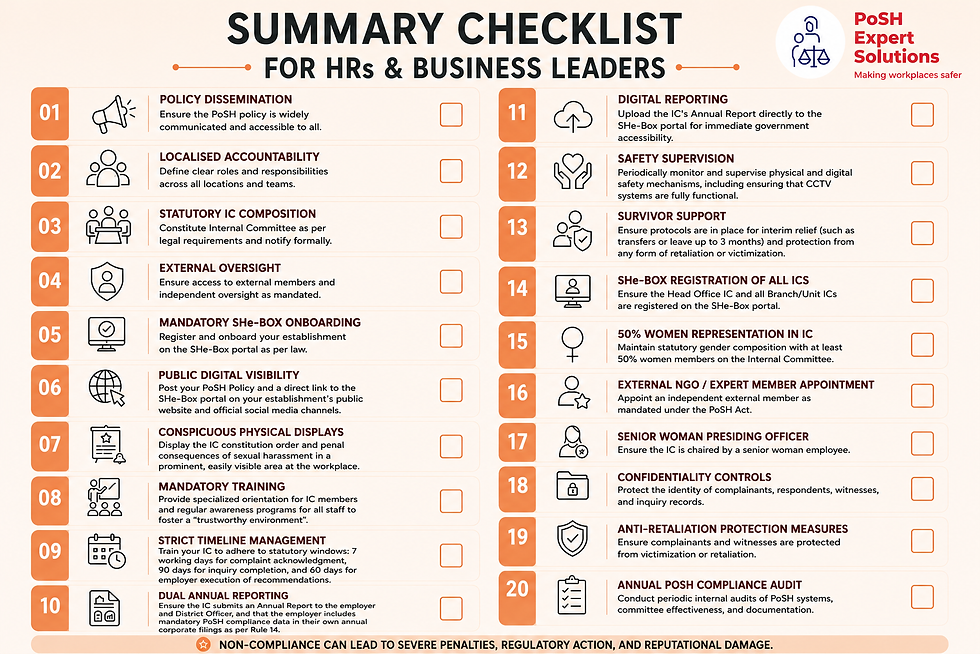
To ensure your organisation can survive a government audit following the new May 15, 2026, Maharashtra PoSH inspection guidelines, here is a quick, readable summary of the immediate changes you must implement:
✓ Formulate and widely disseminate a PoSH policy that explicitly covers remote, virtual, and work-from-home (WFH) environments to all employees, interns, and contractual staff.
✓ Ensure every individual office or unit has its own dedicated Internal Committee (IC); relying on a "common committee" for multiple locations is a direct contravention of the Act.
✓ Verify each IC has at least 4 members, is minimum 50% women, and is led by a senior-level woman employee as Chairperson.
✓ Embed a qualified independent external member from an NGO or an association committed to the cause of women into every IC.
✓ For every office with 10 or more employees, appoint a Nodal Officer and upload their details—along with full IC member details for all branches—to the SHe-Box portal.
✓ Post your PoSH Policy and a direct link to the SHe-Box portal on your establishment’s public website and official social media channels.
✓ Physically display the order constituting the IC and the penal consequences of sexual harassment in a prominent, easily visible area at the workplace.
✓ Provide specialised orientation for IC members on handling complaints and conduct regular awareness programs for all staff to foster a "trustworthy environment".
✓ Train your IC to adhere to statutory windows: 7 working days for complaint acknowledgment, 90 days for inquiry completion, and 60 days for employer execution of recommendations.
✓ Ensure the IC submits an Annual Report to the employer and District Officer, and that the employer includes mandatory PoSH compliance data in their own annual corporate filings as per Rule 14.
✓ Upload the IC's Annual Report directly to the SHe-Box portal for immediate government accessibility.
✓ Periodically monitor and supervise physical and digital safety mechanisms, including ensuring that CCTV systems are fully functional.
✓ Ensure protocols are in place for interim relief (such as transfers or leave up to 3 months) and protection from any form of retaliation or victimisation.
Conclusion
The regulatory framework has finally caught up to the realities of modern corporate failures. The "zero compliance" findings in the TCS Nashik case—ranging from non-functional security systems to a complete lack of local grievance mechanisms—have proven that a centralised, "paper-only" approach is no longer acceptable. Under the new Maharashtra guidelines, compliance can no longer live inside a locked drawer; it must be active, digital, and thoroughly trained to ensure a safe environment for every employee, whether they are in a physical office or working remotely.
Is your organisation compliant with the newly issued government inspection guidelines? Don’t wait for an external audit or an internal crisis.
Contact POSH Expert Solutions today to review your website visibility, onboard external members, and train your IC committee to insulate your business from liability.


The biggest mistake that Internal Committee (IC) members are making nowadays is assuming that "no complaints means no need to hold quarterly IC Member Meetings."
Following the landmark June 19, 2026 National Commission for Women (NCW) advisory, a massive nationwide push is underway to implement mandatory annual POSH audits specifically to weed out "paper-only" compliance. Maharashtra has already spearheaded this enforcement by authorising physical inspections to verify active compliance on the ground.
Even if your organisation has received zero active complaints this quarter, your IC must still meet quarterly to review preventive measures, virtual workplace safety, and awareness initiatives. Maintaining detailed meeting minutes and proof of these operational reviews is absolutely non-negotiable—it is the only legal evidence that proves your committee is…